Noise Reduction Coefficient (NRC) has very limited utility in music applications and is often misleading if relied upon for critical listening or recording environments.
The NRC is useful in architectural acoustics for improving speech privacy in open spaces like offices and classrooms. However, achieving balanced energy across the full audible spectrum is essential for balanced acoustic design in music.
Why NRC Falls Short for Music
- Narrow Frequency Window: The Noise Reduction Coefficient (NRC) is the average of sound absorption at four specific frequencies: 250 Hz, 500 Hz, 1000 Hz, and 2000 Hz. This average is rounded to the nearest 0.05. The NRC does not consider low sound energy below 250 Hz or high sound frequencies above 2000 Hz.
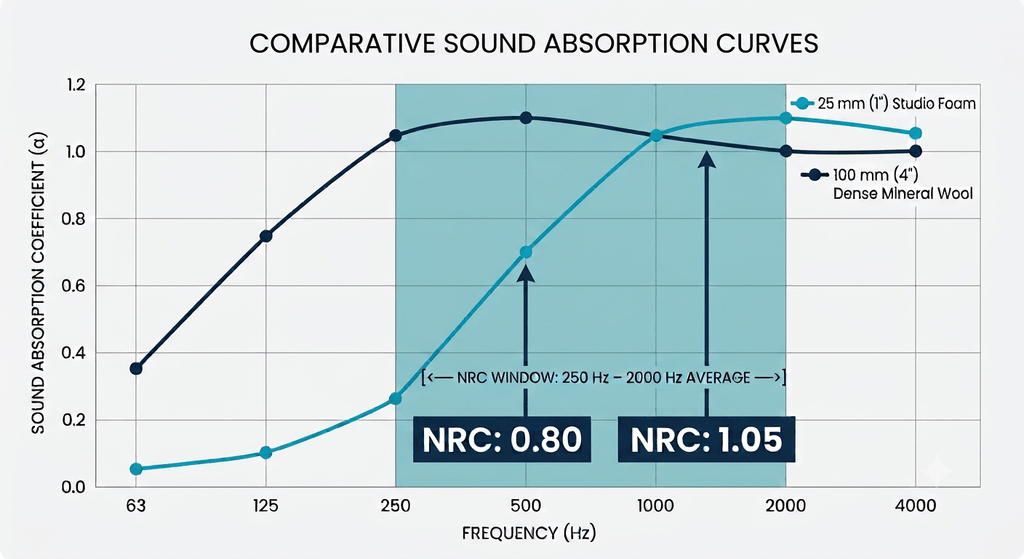
- Hides the Low-Frequency Problem: In music rooms, the primary acoustic issues almost always occur below 200 Hz (room modes, SBIR, and boundary loading). A thin, 25 mm foam panel can achieve an NRC of 0.70 to 0.80 by heavily absorbing upper-mids, while offering virtually zero absorption at 80 Hz.
- Encourages Spectral Imbalance: Focusing exclusively on materials with high NRC ratings often leads to “dead, boomy” rooms. While high and mid frequencies are reduced, issues with bass and low-mid modal ringing remain unresolved.
- Averages Out Narrow-Band Deficiencies: A panel with strong absorption at 1 kHz and 2 kHz but poor performance at 250 Hz can still yield a respectable NRC number, masking a non-linear decay curve.
NRC vs. Music Requirements.
| Feature | NRC (ASTM C423 / ISO 11654 equivalent \alpha_w) | What Music Acoustic Design Needs |
|---|---|---|
| Bandwidth Evaluated | 250 Hz – 2 kHz (averaged) | 20 Hz – 20 kHz (full-spectrum detail) |
| Bass Assessment | None (blind below 250 Hz) | Critical evaluation at 30 Hz – 200 Hz (sub/bass modal control) |
| Metric Type | Single-number, coarse average | 1/3-octave frequency absorption curves (\alpha per band) |
| Primary Goal | Speech intelligibility, background noise attenuation | Flat decay time (60 / ), modal control, phase preservation |
NRC can be a helpful starting point in music environments, ensuring surfaces aren’t overly reflective in the mid-range. However, for precise acoustic modelling, monitoring accuracy, or studio design, it’s best to rely on detailed 1/3-octave absorption data.
The problem illustrated.
Below is a chart of two products with similar NRCs (20% variance) but very different absorption profiles. The overachievement of the foam at 1 kHz and 2 kHz compensates for the underperformance at 500Hz and 250Hz. The chart shows why NRC is not very useful. 20% variance in NRC value but dramatic difference in absorption profile.